
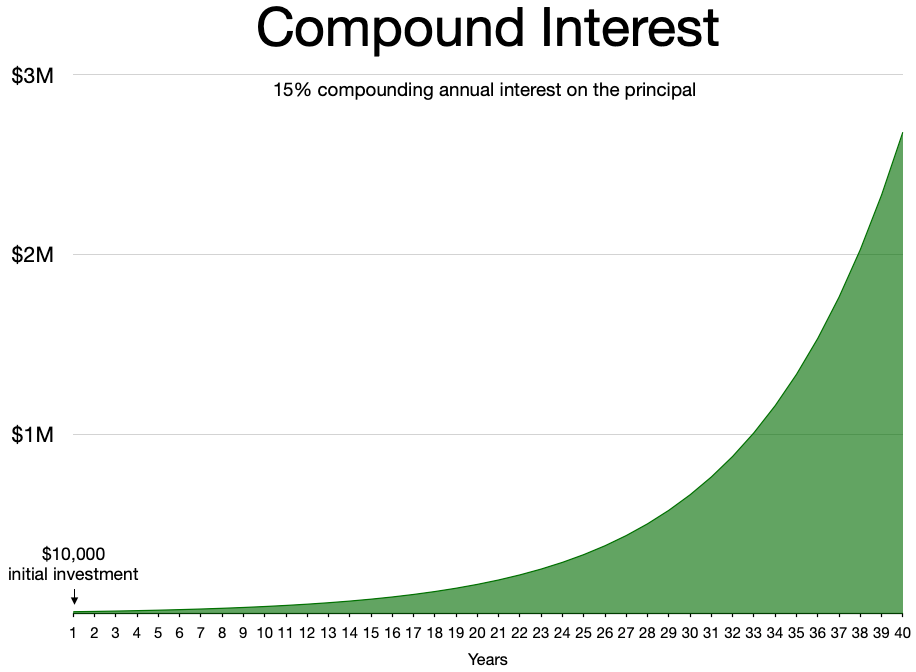
Imagine your savings growing like a snowball rolling down a hill, getting bigger as it goes. This is essentially what compound interest does for your money. Unlike simple interest, which only earns you interest on the initial amount, compound interest lets you earn interest on top of interest.
This means your money can grow faster over time.

Compound interest can work wonders with both savings and investments. By keeping your money invested or saved longer, you get even more benefit. It’s like giving your money little boosters at regular intervals. With even a modest interest rate, your savings can increase significantly over the years.
Knowing how compound interest works helps you make smart decisions about where to keep your money. Whether it’s a savings account, a retirement fund, or an investment, understanding how often the interest compounds is important. This frequency could be annually, semi-annually, quarterly, or even monthly, and it makes a difference in how much your savings grow.
Contents
Understanding the Basics of Compound Interest
Compound interest is a key concept in finance that can significantly impact your savings and investments. Unlike simple interest, compound interest grows over time, leading to more substantial returns.
Defining Compound Interest
Compound interest is interest on interest. This means you earn interest on both the initial principal and the accumulated interest from previous periods. Think of it as a snowball effect, where your money grows faster over time.
For example, if you deposit $100 into a savings account with an annual interest rate of 5%, you would earn $5 in the first year. In the second year, you’d earn interest not just on the initial $100 but also on the $5 interest added.
Compound Interest vs. Simple Interest
Simple interest is calculated on the original principal only. With simple interest, if you deposit $100 at a 5% interest rate, you earn $5 every year. Your money doesn’t grow as quickly as with compound interest.
Here’s a quick comparison:
Simple Interest Formula:
( \text{Interest} = \text{Principal} \times \text{Rate} \times \text{Time} )Compound Interest Formula:
( \text{A} = \text{P} (1 + \frac{r}{n})^{n \times t} )
This fundamental difference makes compound interest a powerful tool for building wealth over time.
The Power of Compounding Over Time
The real magic of compound interest is seen over long periods. The longer your money stays invested, the more it grows. This is why it’s crucial to start saving early.
Using the Rule of 72 can help you estimate how quickly your investment might double. Divide 72 by the annual interest rate to get the number of years needed. For example, with an 8% interest rate, your money would double in 9 years (72/8).
Starting early with compound interest means you can benefit from exponential growth, leading to significant increases in your savings and investments over time.
Calculating Compound Interest
When calculating compound interest, you use a specific formula. You can also use online calculators for quick results. Various factors influence these calculations.
The Compound Interest Formula
To calculate compound interest, you’ll need to use the formula:
[ \text{A} = \text{P}(1 + \frac{r}{n})^{nt} ]
- A is the future value of the investment/loan, including interest.
- P represents the principal investment amount.
- r is the annual interest rate (decimal).
- n is the number of times interest is compounded per year.
- t stands for the number of years the money is invested or borrowed.
By plugging values into this formula, you can find out how much your investment will grow over time.
Using Compound Interest Calculators
The ease of using an online compound interest calculator makes it a popular choice. These calculators allow you to quickly input your principal amount, interest rate, and time frame to find the future value.
Key Steps:
- Enter initial deposit or loan amount.
- Input the expected annual interest rate.
- Select how often the interest compounds (monthly, quarterly, annually).
- Specify the period for the investment or loan in years.
Calculators like those offered by financial sites help you visualize potential gains without manual calculations.
Factors Affecting Compound Interest Calculation
Several factors can affect how compound interest builds up over time:
- Principal Amount: A larger initial investment increases potential earnings.
- Interest Rate: Higher rates significantly boost your returns.
- Compounding Frequency: Interest compounded more frequently (e.g., monthly) can lead to higher totals.
- Duration: Longer investment periods generally yield more interest.
Understanding these elements helps you make informed decisions about loans or investments. Choosing the right combination ensures you maximize your financial goals.
Factors Influencing Compound Interest
Compound interest is shaped by several key factors, including how much you start with and how often you add to it. These factors change how your investment or savings grow over time.
Principal Amount
The principal amount is the initial sum of money you deposit or invest. Starting with a larger principal gives your investment more room to grow.
For example, if you put $1,000 into an account, it will earn interest on this full amount from the start. Meanwhile, a smaller principal like $100 will grow more slowly since the interest is calculated on a lesser base. This foundational amount sets the stage for all future growth through compounding.
Interest Rate and Compounding Frequency
The interest rate significantly affects how much your money grows. Higher interest rates mean more returns on your starting amount, or principal. For instance, at a 5% rate, your investment will grow faster than at 2%.
Compounding frequency is about how often interest is added to the principal. It can be daily, monthly, or yearly. More frequent compounding increases your returns. Daily compounding, for instance, can lead to better outcomes than monthly compounding since interest is calculated more often.
The Effect of Time on Compounding
Time is crucial in the compounding process. The longer your money is invested, the more potential it has to grow. Compounding relies on earning interest on previously earned interest, which means extended periods can lead to significant growth.
For example, investing for 20 years rather than 10 can lead to considerably higher returns. The number of years your money stays invested allows interest to work its magic, leading to exponential growth over time.
Additional Deposits and Regular Contributions
Making additional deposits or regular contributions greatly impacts how compound interest benefits you. If you continuously add money to your investment or savings account, the principal grows, allowing for more interest to accumulate on a larger base.
Regular contributions, like monthly deposits, can substantially boost your end balance. By consistently adding funds, you are increasing the total amount that earns interest, which can significantly amplify the effects of compounding over time.
Compound Interest in Different Financial Products
Compound interest is a powerful tool that can significantly grow your wealth over time. It’s used in many financial products, including savings accounts, investments, and retirement accounts, allowing your money to earn interest on both the initial amount and the accumulated interest from previous periods.
Savings Accounts and High-Yield Savings Accounts
In a savings account, your money earns interest that’s compounded, meaning you earn interest on your initial deposit and on the interest that accumulates. Most standard savings accounts offer lower interest rates, but they are a secure way to let your money grow slowly.
On the other hand, high-yield savings accounts offer higher interest rates. These accounts may require larger initial deposits or maintain a minimum balance but provide an opportunity to earn more significant interest over time. While both account types are safe, high-yield accounts can accelerate your savings thanks to higher compounding rates.
Investments: Stocks, Bonds, Mutual Funds, and ETFs
Investments like stocks and bonds benefit from compound interest by reinvesting earnings. For instance, if you own shares of a mutual fund, the dividends can be used to buy more shares, increasing your principal amount. This reinvestment helps your investment grow faster over time as you earn returns on an ever-growing amount.
ETFs, or exchange-traded funds, operate similarly, where dividends might be reinvested to buy more shares. Compound interest in investments is most effective over longer periods, allowing the reinvestment of dividends and interest to significantly boost your investment returns. Here, patience truly pays off with potentially larger financial gains.
Retirement Accounts: 401(k)s and RESPs
With 401(k)s, compound interest works by reinvesting earnings into your retirement savings. Contributions are often matched by employers, amplifying the benefits of compounding. As your account grows, so does the interest earned, enabling a substantial nest egg to build up by retirement.
RESPs (Registered Education Savings Plans) in countries like Canada use compound interest to help save for future education costs. You contribute money, which earns compounded returns, increasing the value of the plan. The government might also offer grants that enhance this growth. These elements combine, allowing for more effective long-term educational savings.
Strategic Use of Compound Interest
Strategically using compound interest can significantly boost your financial goals. By making informed choices, starting early, and being cautious about debt, you can maximize your wealth accumulation.
Financial Planning and Retirement Planning
When planning for the future, using compound interest can be a smart move. It helps your savings grow without much extra work on your part. By setting clear financial goals and investing regularly, you can watch your money grow over time.
Retirement planning benefits from compounding as it allows your retirement funds to increase significantly. The earlier you start, the more time your money has to grow, ensuring a more comfortable retirement.
Consider different types of retirement accounts like 401(k or IRA that offer compounding benefits. Regular contributions to these accounts can lead to significant growth due to compounding at a higher rate.
Starting Early to Maximize Interest Accumulation
Starting early is crucial to make the most of compound interest. The key is in the time your money has to grow. Money left to compound over many years can grow exponentially. It’s often said that time is on your side in investing.
Small amounts deposited early can turn into substantial sums due to accumulated interest. The longer your investment horizon, the more dramatic the growth due to the interest-on-interest effect.
Keeping a consistent habit of saving and investing from a young age can lead to financial security later in life. This approach doesn’t just apply to big investments but to small, regular contributions as well.
Avoiding Debt to Leverage Compounding
Debt can be a barrier to benefiting from compound interest. High-interest debts, like credit card debt, can quickly erode your savings. Instead of accruing wealth, you end up paying more in interest than you gain.
Avoiding unnecessary debt allows you to focus on building your investments. Paying down existing high-interest debt should be a priority to maximize your wealth-building potential. Freeing yourself from debt gives more room to take advantage of compounding.
Strategically managing and minimizing debt ensures that your financial decisions are working towards building your net worth rather than diminishing it.
Advanced Concepts in Compound Interest
Exploring advanced concepts in compound interest can help you make better financial decisions. Understanding how the Rule of 72, inflation, and continuous compounding affect your investments can give you a deeper insight into the growth of your savings.
Understanding the Rule of 72
The Rule of 72 is a simple way to estimate how long it takes for your money to double with compound interest. By dividing 72 by your annual interest rate, you get an approximation of the years needed to double your investment.
For instance, if your interest rate is 6%, dividing 72 by 6 gives you 12. So, it will take about 12 years to double your money. The Rule of 72 helps you quickly gauge the impact of different interest rates on your savings growth.
Impact of Inflation on Compound Interest
Inflation can significantly affect the real value of your compounded savings. Though your account balance might grow, inflation slowly eats away at your purchasing power. If your account earns a compounded rate of 5% annually, but inflation is 2%, the real growth rate is reduced to just 3%.
Understanding the relationship between inflation and the effective annual rate of return can help you set realistic expectations for your investments. Always consider the inflation rate when planning your long-term finances to ensure your savings grow in real terms.
Continuous Compounding and Its Applications
Continuous compounding is a concept where interest is calculated and added to the account balance an infinite number of times per period. This method leads to slightly higher returns compared to standard compounding frequencies.
The formula for continuous compounding is:
FV = PV * e^(r * t)
Here, FV is the future value, PV is the present value, r is the annual interest rate, and t is time in years. e is a constant approximately equal to 2.71828.
Continuous compounding is used in fields like finance and engineering, where precise calculations of growth are necessary. Understanding this concept can be crucial for specific investments and saving strategies where maximizing return is important.
Practical Tips for Maximizing Compound Interest
Maximizing compound interest involves thoughtful choices about compounding periods, understanding the effect of those choices on your finances, and considering expert advice. It’s more than just letting your money sit; it requires strategic action at every step.
Selecting Compounding Periods for Best Returns
Choosing the right compounding period can significantly affect your returns.
Annual compounding calculates interest once a year.
Monthly compounding adds interest twelve times yearly, often leading to more earnings.
Quarterly compounding strikes a balance, calculating four times annually.
For better results, consider how frequently interest is added. Generally, more frequent compounding periods (like monthly) generate higher returns, given the same interest rate. Examine your options and select a period that aligns with your financial goals.
Assessing the Role of Compounding in Financial Decisions
When making financial decisions, consider how compounding can increase your returns. It’s crucial to think about timespan and the power of earned interest.
The longer your money compounds, the more it grows.
Use the rule of 72 to estimate how fast your investment can double. Divide 72 by your investment’s annual interest rate to estimate the years required. This quick calculation helps determine the benefit of compounding in long-term goals, like retirement savings.
Consulting a Financial Advisor for Personalized Strategies
Hiring a financial advisor can be beneficial when dealing with compounding interest, especially if you’re new to investing. They offer personalized guidance based on your specific situation.
Advisors help craft strategies tailored to your risk tolerance and financial objectives. Ask about the best compounding options given your current assets and needs.
Advisors can also keep you updated on changes in the market that might affect your choices. Regularly consulting an advisor ensures your compounding strategy remains aligned with your financial plans.


